Sardinia Road Trip: 7 Destinations and a Hidden Gem to visit by car
Sardinia’s beaches are famous worldwide, and honestly, that reputation is completely deserved. But here is what most people miss: the real Sardinia is not on the beach. It is inside 3,500-year-old stone towers, hanging off cliffs where miners once loaded ships through holes in the rock, and sitting in medieval towns that look like they were painted by hand.
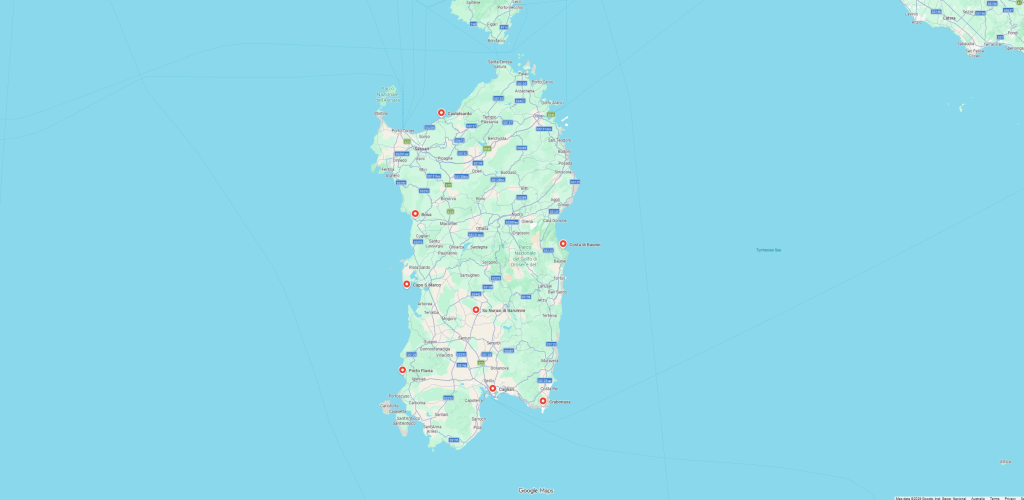
In this guide, you will discover seven stops — plus one hidden gem — that I think represent the very best of Sardinia by car. I have arranged them into a loop that starts and ends in Cagliari, but if you are flying into Olbia or Alghero, simply join the route at the nearest point.
By the way, you can find a few great car rentals in Sardinia, doesn’t matter which airport you arrive.
Cagliari — The Capital Nobody Expects
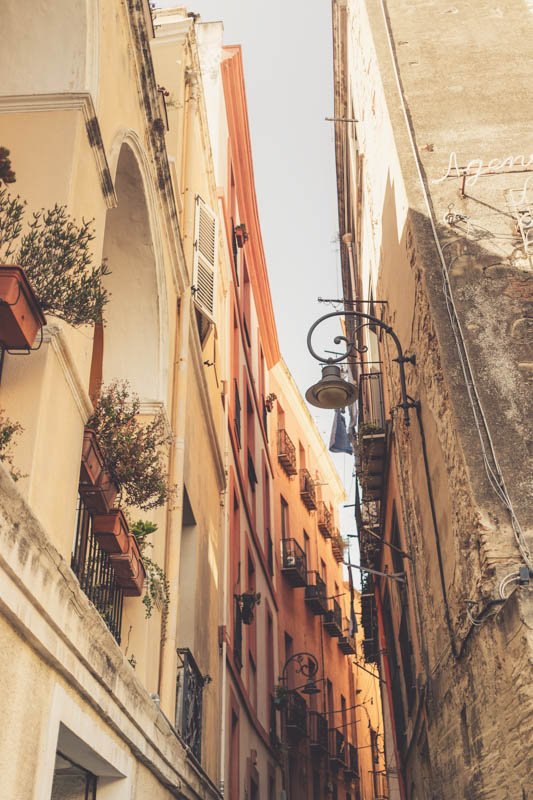
Most visitors treat Cagliari as nothing more than an airport pickup point. That is a genuine mistake. The Castello district sits on a rocky hill above the city, surrounded by 13th-century Pisan walls, with towers that have watched over the Gulf of Cagliari for 800 years. The terraces looking south across the lagoons have a light and landscape that feels almost North African.
Park at the base of the hill and walk up. The Cathedral of Santa Maria, the Elephant Tower, and the views from San Pancrazio are all within a short walk. Give it at least a morning, preferably before the heat arrives.
The anecdote: During World War II, Allied bombers targeted Cagliari heavily because of its strategic port. But the residents of the Castello district had an idea. They laid white sheets across the medieval roofs to signal “this is historic, not military.” The bombers largely respected it, and the 13th-century walls survived while much of the modern city around them was flattened. It is one of the few cases in Europe where a medieval centre survived a bombing campaign because the locals essentially crowd-sourced a “do not bomb” sign.
Villasimius — The Beaches That Were Off-Limits for 50 Years
From Cagliari, head southeast along the coast for about 50 kilometres. The road gets progressively more beautiful with every kilometre until you reach Villasimius — the southeastern tip of the island and one of the most beautiful beach areas in all of Italy.
White sand, shallow turquoise water, and a marine reserve that protects the coastline from overdevelopment. Italians know it well. The rest of the world has barely discovered it. The best beaches — Spiaggia del Riso, Punta Molentis, the coves inside the Capo Carbonara reserve — are spread along a coastline that no bus serves properly.
The anecdote: Until 1998, the entire Capo Carbonara peninsula was a restricted military zone. The Italian navy used it for exercises, which meant no tourists, no beach clubs, no hotels, no development whatsoever. When it was finally decommissioned and turned into a marine reserve, the beaches were in essentially the same condition they had been for centuries. That is why the sand is so white and the water so clear — it was literally off-limits to civilians for half a century.
You can visit most of these places also by public transportation; however, you will need more time – so much more that you will probably need twice as much time by bus and train, and you won’t be able to stop in the occasional villages along the route that will enhance your experience so much!
That’s why I always suggest renting a car in Sardinia. You transform your holiday from a destination-to-destination trip into a real experience to remember forever.
You do not need any fancy car, but you do need to book early, especially for July and August when availability becomes an issue.
I personally always use DiscoverCars, the comparison platform that works as a sort of Airbnb for rentals, with real customer ratings from people who actually completed a trip. I filter above 8 or even 9 stars to shortlist the most trusted operators and lock in the rate. Cancellation is free up to 48 hours before pickup, so there is no reason to wait.
Costa di Baunei
From Villasimius, head up the east coast to the Costa di Baunei, where the landscape changes completely. The flat southern coast gives way to dramatic limestone cliffs dropping straight into the sea. This stretch contains two of the most extraordinary beaches in the Mediterranean.
Cala Goloritzé is an Italian National Monument, a natural rock arch, a limestone pinnacle rising from the water, and shades of blue that look almost artificial. You reach it by a four-kilometre hike from the plateau above, or by boat from Arbatax. Just north is Cala Mariolu, with white and pink pebbles and water that shifts between turquoise and deep blue.
The road along the Baunei plateau — the Orientale Sarda — is spectacular in itself, high above the sea with views at every turn.
The anecdote: Cala Goloritzé did not exist in its current form until 1962, when a massive landslide crashed into the sea and created the cove, the beach, and the famous rock arch. Before that, it was just cliff. The limestone pinnacle — called the Aguglia — is now one of the most famous rock climbs in Europe, but the entire landscape is a geological newborn.

Castelsardo — The Town Everyone Drives Past
Continue north for about four hours to Castelsardo, a medieval hilltop town built on a volcanic promontory above the sea. Most visitors drive straight past it on their way between Alghero and the Costa Smeralda. What a mistake.
The Aragonese castle watches over genuinely medieval cobblestone lanes — not restored medieval, actually medieval — and the views across the Gulf of Asinara are extraordinary. It is far less visited than Alghero, far more authentic, and far better value for a meal or a night’s stay.
The anecdote: Just outside town is the Roccia dell’Elefante — a massive trachyte boulder that looks exactly like an elephant, complete with trunk and ears. It was not carved; it is a natural formation shaped by wind and water over millennia. But here is the catch: Neolithic people looked at this elephant-shaped rock 5,000 years ago and decided it was the perfect place to bury their dead. They carved chambers inside it and used it as a tomb. It is called a Domus de Janas — the House of the Fairies — and it is one of the most surreal prehistoric sites in Italy.

Bosa
From Castelsardo, drive south to Bosa. Make sure to take the coastal road down from Alghero — the SS292 — which is one of the most beautiful drives in Sardinia. Cliffs, wild coastline, colours that make you pull over every five minutes.
Bosa sits on the Temo River — the only navigable river in Sardinia — with the Malaspina Castle on the hill above and painted fishermen’s houses in every shade of orange, yellow, and pink along the riverbank. It does not have the dramatic beaches of the east coast, but it has something harder to find: a genuine, lived-in beauty that feels earned rather than packaged.
There are many places to stay in Sardinia, and Bose is certainly one of my favourites, not only because it is a beautiful town, but also because it has still kept its charming local character.
The anecdote: The painted houses were originally colored so that fishermen could identify their homes from the sea. Each family chose a distinct shade — orange, yellow, pink, ochre — creating a kind of colour-coded navigation system. What looks today like an artist’s palette started as practical signage. When a fisherman was returning with his catch, he looked at the hillside and knew exactly which pink house was his.

Capo San Marco — Phoenicians, Pirates, and Flamingos
South of Bosa, you will find one of the most underrated peninsulas in Sardinia. Capo San Marco, on the Sinis Peninsula, combines three things almost nowhere else on the island manages in one spot.
First, Tharros — ancient Phoenician and Roman ruins on a peninsula above the sea, with columns still standing and mosaics still visible after 2,500 years. Second, a 16th-century Spanish watchtower sitting on the tip of the peninsula. Third, a double beach on both sides of the narrow strip with shallow, calm water and white sand. The drive out is flat and straight through wetlands full of flamingos.
The anecdote: The Spanish tower was one of over 80 watchtowers built around Sardinia in the 16th century to spot Barbary pirates from North Africa. When a pirate ship was spotted, the keeper lit a fire, and the next tower repeated the signal, creating a chain of warnings that could travel the entire coast in hours. These towers saved thousands of Sardinians from being kidnapped and sold into slavery in Algiers and Tunis. The network was essentially a 16th-century emergency broadcast system made of stone and fire.
Su Nuraxi di Barumini
Cut inland from the west coast to Barumini, where you will find Su Nuraxi, a UNESCO-listed nuraghe, a prehistoric stone tower complex that has been standing for 3,500 years. The main tower and its surrounding village are extraordinarily well preserved.
No bus from the coast reaches it. Almost no international tourists visit despite it being genuinely one of the most important prehistoric sites in Europe. Worth an hour of your time and completely worth the inland detour.
The anecdote: In 1950, a local farmer named Bartolomeo Melis was ploughing his wheat field when his plough hit a large stone. He dug around it and realised it was the top of a massive stone tower buried under earth. Archaeologists excavated and found an entire prehistoric village perfectly preserved beneath a mudslide. It had been hidden for 3,000 years, right under a working farm. Today it is the most important nuraghe on the island.

Porto Flavia — The Hidden Gem Named After a Daughter
And now the hidden gem I promised. The one I said was genuinely one of a kind in the entire world.
Porto Flavia sits on the southwest coast in an old mining region called the Sulcis that most tourists have never heard of. It is an industrial loading port built in 1924, carved directly into a cliff face 40 metres above the sea. Two tunnels, 600 metres long, were bored through solid rock to connect inland silver and lead mines to a loading platform hanging above the waves.
Ore was loaded directly onto ships waiting in the open water below — no harbour, no docks, no breakwater. Just a hole in the cliff and a lot of engineering courage.
Guided tours run inside the tunnels. The view from the platform is unlike anything else in Sardinia.
The anecdote: The engineer who designed it, Cesare Vecelli, named the port after his daughter, Flavia. So this dramatic industrial monument — this feat of engineering that was considered one of the most advanced in the world when it opened — is essentially a father’s love letter carved into limestone. The “port” had no port at all, yet it cut loading time from two weeks to two days. When the mines closed in the 1960s, the site was abandoned and nearly forgotten. Today, standing on that platform with the Tyrrhenian Sea below you and the history of an entire mining community around you, it is the kind of moment that makes you very glad you had a car and a willingness to take the road that does not appear in guidebooks.

Practical Notes for the Road
Car size: Stick to a compact. Sardinia’s coastal roads are narrow, mountain lanes are tighter still, and parking in the old towns is genuinely challenging with anything larger. Automatics are available but cost roughly €15–€20 more per day.
Ferries: If you are island-hopping to the Maddalena Archipelago from the north, book car ferry slots well in advance in summer.
Insurance: I always add full coverage through DiscoverCars for €8–€10 per day. The rural lanes, tight village streets, and occasional scratch from a stone wall make it a no-brainer. Your credit card coverage probably has a €700 excess, which makes it useless for the small dents that actually happen here.
Timing: This loop works comfortably in ten to fourteen days. Less than that and you are rushing. More than that and you will start finding your own hidden gems, which is honestly the whole point.

Final Word
Sardinia is not a place to tick boxes. It is a place to drive slowly, stop often, and let the island surprise you. These seven stops — and Porto Flavia, the hidden gem that most people miss — are my starting point. But the real magic happens in the gaps between them: the roadside bakery you did not plan for, the shepherd’s track that leads to a view you cannot find on Instagram, the village where nobody speaks English and lunch takes three hours.
Book the car early, pack a camera, and give yourself time. Sardinia will do the rest.
